
Most brands and agencies walk into a production with references, a mood, and a general direction. That's a starting point, not a brief. Creative strategy for video and photography is what turns a folder of saved posts into a shot list that actually shoots the thing you pictured. Here's what that process looks like and why it changes the work.
Forty Saved Posts and a Feeling
Open any brand's camera roll before a production brief call. Saved Instagram posts. Screenshots from other people's campaigns. A Pinterest board going in three directions at once. Moody editorial. A brand film that felt cinematic. A competitor's work that did something nobody in the room can name but everyone wants.
That's the vibe. It's real information. It is not a strategy.
The gap between having a reference and knowing how to execute it is where most productions lose the plot. Not because the client doesn't know what they want. They usually do. The problem is that "I want it to feel like this" and "here's what we're shooting Tuesday" are two different languages. Someone has to translate between them before the shoot, not during it.
That translation is creative strategy.
The Decisions Nobody Makes Until It's Too Late
A real creative strategy session doesn't ask how something should feel. It decides what that feeling requires on set.
Location is inseparable from mood. Gritty and textured reads differently in a converted warehouse than in a rental studio with the right props. That's not a preference call, it's a production call. Natural light versus controlled light determines what you can and can't control, what the talent is doing, how much schedule buffer you need. The reference image you saved doesn't make that call for you.
Color palette on set affects the grade in post. If the campaign is going to live in cooler tones, warm earth tones in wardrobe will fight the edit at every step. These decisions are connected. Someone has to connect them before the crew arrives.
There's a difference between a shot list that documents what happened and a shot list that builds a visual language. The first gives you coverage. The second gives you a campaign. Strategy is what produces the second kind.
For video, pacing is partly a pre-production decision. Faster cuts need more setups. Longer, more breathing cuts need patience on set and talent who can hold a moment. You can't edit energy into footage that didn't have it.
None of this is obvious from a mood board. All of it has to get decided before the shoot.
Photography Has Nowhere to Hide
There's a version of this conversation that's mostly about video. But creative strategy matters even more for photography.
Video has motion, music, pacing, narration. Multiple frames working together across time. A weak shot can be cut around. A strong sequence can carry a shaky individual frame.
Photography doesn't have that. Every image stands alone. The light, the composition, the expression, the relationship between subject and background. It's either there or it's not. You can't edit your way out of a photograph that didn't have a point of view going in.
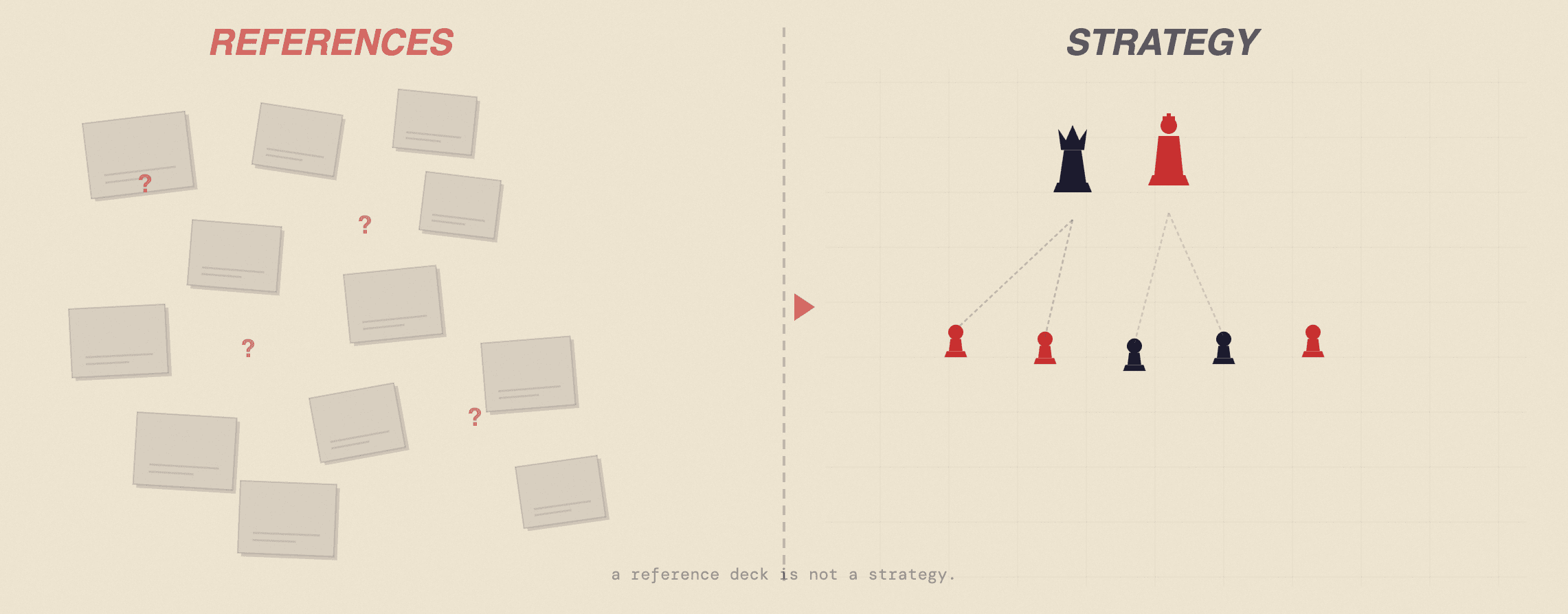
We've seen campaigns come in with a full reference deck, a strong photographer, and a talented team and still produce work that felt generic. The brief was loose. The location was chosen on availability. The wardrobe was "whatever looks professional." The photos came back looking like stock photography. Nobody made a mistake. There was just no strategy.
This happens more than people want to admit. The references never get blamed for it. They should. A mood board without a brief is decorative. It shows everyone what it should feel like and then leaves the hard decisions for shoot day, where there's no time to make them well. We've written about how mood boards actually function in a production brief. The strategy conversation comes before that document even gets made.
The Questions That Change the Work
A real creative strategy conversation starts somewhere different than most production briefs do.
What does this content need to do in the first three seconds? What does it sit next to on someone's feed, and how does it need to feel relative to that? If someone saw one frame from this production, which frame would it be and what would it tell them?
These aren't questions reserved for big agency productions. They're the questions that determine whether a shoot delivers something useful or something expensive that missed.
When they get answered before the shoot, the work shows it. Every location choice, every lighting setup, every moment the camera lingers has a reason behind it. The reference deck stops being the goal and starts being what it was always meant to be: the conversation starter.
When they don't, the references stay references. The final product looks like someone else's idea of your brand, and nobody can quite explain why.
You can see the kind of work that starts with this conversation on our work page.