
Most video production companies give you three rounds of revisions and a clause you won't read until you need it. We stopped counting rounds and started finishing projects. Here's what it looks like when your deadline is our deadline and the video ships when it's right.

You've Seen the File. You've Named the File.
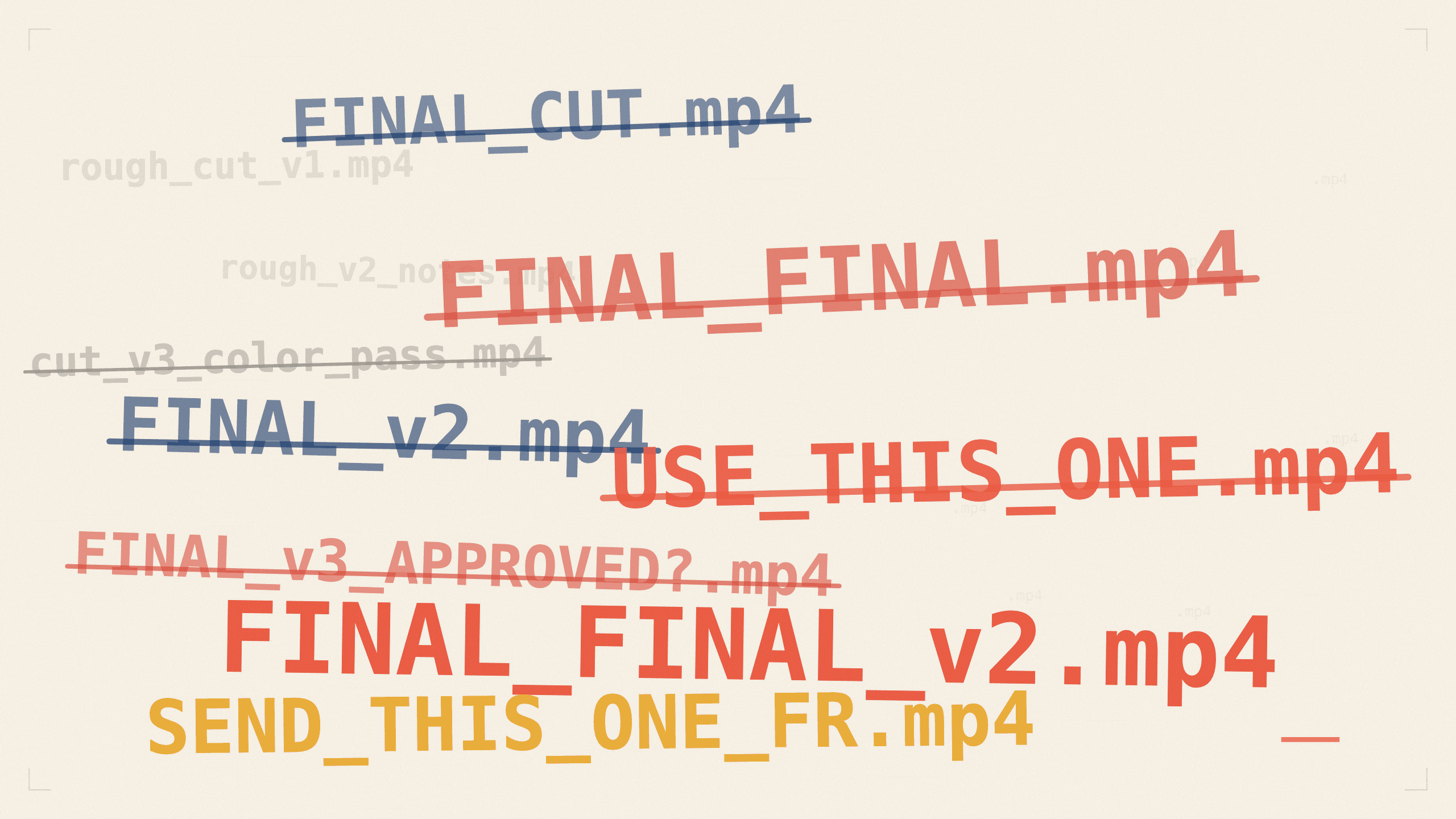
"Final_Cut_v3_FINAL_FINAL_v2_rough_color_fixed_SEND_THIS_ONE.mp4"
If you've worked in video, you've named this file. If you've hired a video production company and never seen this file, you worked with patient people who hid it from you. Ha.
Every suffix is a chapter. "Rough_v1" is optimism. "Final_v2" is the first compromise. "FINAL_FINAL_SEND" is someone who needed it to be over more than they needed it to be right.
We know that folder. We've been in enough post-production suites to know exactly what it costs when a project ends that way.
"Three Rounds" Is a Policy, Not a Project
Most agencies write a revision limit into the contract. Three rounds, sometimes five if you pushed hard during the proposal. It lives in a section nobody reads until round three lands and the project still isn't there.
The logic makes sense on paper. Open-ended revisions without a defined scope is how projects stay alive for six months and teams burn out on a single job. We understand the instinct.
But a revision cap tells the client one thing clearly. Our process ends before your project is finished.
When the rounds run out and the video doesn't work, someone is about to do something uncomfortable. Either the client signs off on a version they don't love, they pay for rounds that weren't in the original scope, or the relationship frays. Those three paths end the same way. A video that doesn't get used the way it should have.
We Don't Track Rounds. We Track Whether It's Done.
We work with you until the project is done. That's the whole policy.
Done meaning you can use it, you're proud of it, and it does what it was supposed to do. Not done as in "we hit a round count and the timer expired."
That doesn't mean open-ended creative drift. If the concept shifts in round six because a stakeholder changed direction, we're having a scope conversation because that's a different project. But if the video isn't landing and we're not done, we don't walk away because a counter hit a number.
What makes this sustainable is what happens before the shoot. We go deep in pre-production, working through objectives, audience, tone, and reference footage together, because the edit is only as strong as the clarity that built it. Most revision spirals start in a kickoff call where something got assumed instead of decided. If you want the full picture on what gets skipped before cameras roll, what your video production company isn't telling you covers the gaps worth knowing.
Good pre-production is the real revision prevention.
When We Get It Wrong, We Fix It
Sometimes the cut doesn't work. Sometimes we misread the brief. Sometimes a client's vision sharpens once they see a first cut and can react to something real instead of imagining it in the abstract.
That's not a client being difficult. That's how creative work works.
We've had projects where the second pass was the one. We've had projects where we went back to the timeline four times before it clicked. The round count didn't matter in either case. What mattered is that we stayed in it.
Your name goes on this video. Your brand is in every frame. Our job isn't finished when the revision counter expires. It's finished when the video ships and does what it was built to do.
If you want to see what a contract built around this kind of commitment looks like, our breakdown of video production contracts covers what to look for before anything gets signed.
"Final Final v2" Stops Here
There's a version of video production where the file names tell the whole story. Each suffix is evidence of a project that ran out of runway before it ran out of problems.
We've seen those hard drives. Sometimes clients bring projects to us after a rough experience somewhere else. Sometimes we're the ones who could have done better on the first pass. In either case, we're working toward the same outcome from the first call.
A file you can use. A clean name. One that gets sent to the team, posted to the website, played in the sales meeting. A video that does what you needed it to do.
That's what done looks like.