
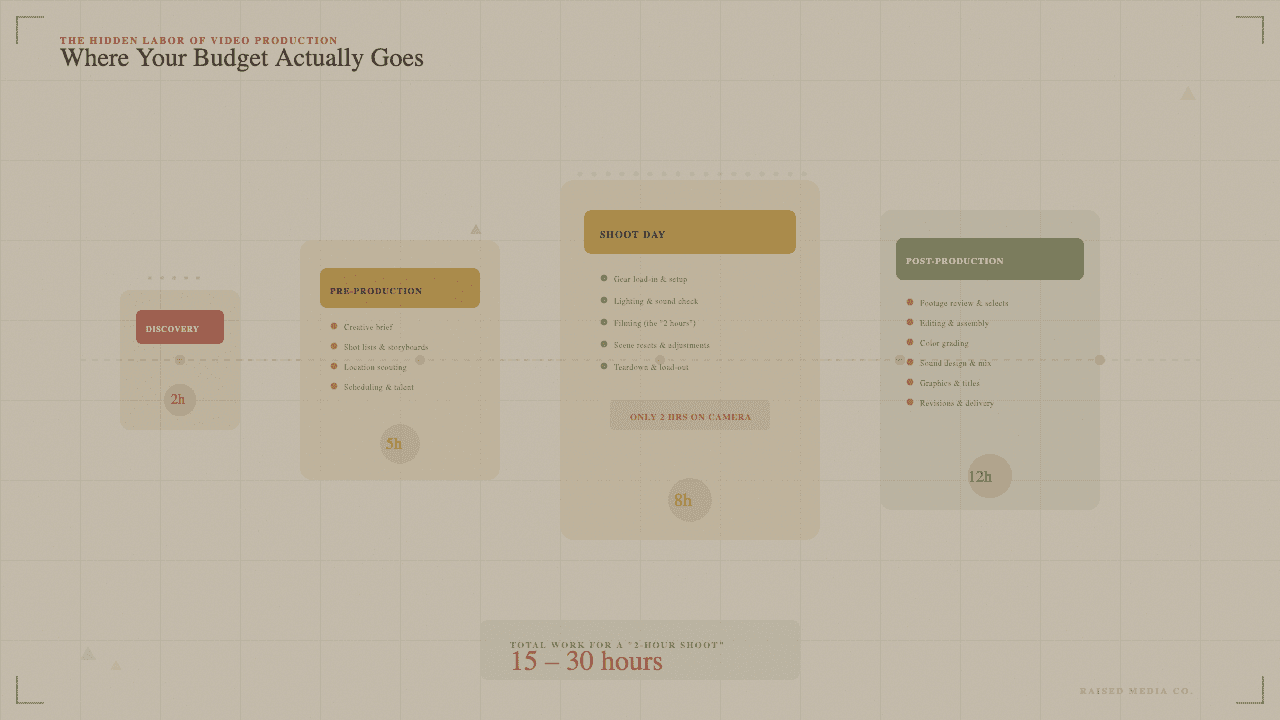
Every video production company that offers a half-day rate is quoting you the part of the job you can see. A two-hour shoot is somewhere between 15 and 30 hours of total work by the time prep, shoot day, and post are done. Here's where all those hours go.

Half-day rates exist because clients picture a two-hour shoot and want to pay for two hours. That's not unreasonable. It's just not how this works.
A two-hour video production shoot is somewhere between 15 and 30 hours of total work. Not because agencies pad time. Because everything that makes a shoot worth doing happens before it and after it. The camera runs for two hours. The job is not two hours.
The Prep Phase Is the Job (You Just Don't See It)
Before anyone is on set, someone has already figured out exactly what needs to happen on set.
Pre-production is where the shoot gets built. Discovery, brief, shot list. What does this video need to accomplish? Who's watching it, and where does it live? Those answers drive everything downstream. The crew and equipment come from the shot list. The shot list comes from the brief.
Location scouting is an assessment, not a walkthrough. Lighting conditions at different times of day, ambient sound, layout, sight lines, power access. Decisions about what the footage will look like get made in that room before any footage exists.
Equipment pull and prep closes out the phase. Batteries charged, cards cleared and labeled, everything tested. A crew that shows up prepared doesn't spend the first hour of shoot day catching up. That prep is invisible on the invoice and it's the reason the day runs.
Depending on the project, pre-production runs 4 to 12 hours.
Shoot Day Starts Before You Arrive
Call time is always before yours.
Setup takes time, and setup done right is what separates a smooth day from one that's catching up all morning. Lighting goes first. A good lighting setup isn't just illuminating the room. It's making a decision about what the whole video feels like. Warm or cool. Soft or directional. High contrast or even and clean. That decision gets made before you walk in.
Audio goes up next. Lavs placed, levels set, room tone recorded, everything tested. Clean audio in the field saves hours in post and makes every word land the way it was meant to.
Then camera checks. Focus, white balance, exposure, frame rate. All confirmed against the shot list.
By the time you arrive, the room is ready. That's not a coincidence.
The shoot itself runs two hours, four hours, whatever was scheduled. The crew works through the list, adjusts when needed, and watches for the moments that weren't planned but are worth catching. Structure exists so that when something real happens, you're ready for it.
Then wrap. Lights struck, cases packed, vehicle loaded. Equipment gets handled carefully because it has another shoot after this one. This part doesn't go fast when it's done right.
When the Crew Leaves, the Video Doesn't Exist Yet
Footage gets offloaded that day. Not the next morning. Backed up to two drives, because the footage is the whole thing.
Then logging. Every clip labeled by camera, scene, take. Unglamorous work and completely necessary, because it's what makes the edit fast and makes sure nothing usable gets missed.
Post-production is where the video becomes a video. Rough cut, refined cut, pacing, structure, story arc. Every clip chosen for a reason. Music sourced, licensed, and timed. Color graded so the footage looks finished and not like raw material. Audio mixed so every voice is clear, every element intentional, every moment lands.
For a two-hour interview shoot, post runs six to ten hours. A brand film goes longer. A project with multiple deliverables, a hero cut plus social cuts plus a clean international version, multiplies from there. The video produthe-brand-launch-film-that-carries-a-new-identity-into-the-worldction contract should have the revision structure in writing before any of this starts.
Then revisions. Two rounds minimum for most projects, and that's normal. Good feedback makes the work better.
No Project Is as Short as It Looks
A restaurant shoot. Two hours, one dining room, some food and atmosphere. Looks like a half-day job.
Pre-production means coordinating with the kitchen, because the hero dish stays camera-ready for about four minutes after it's plated. The scout covers which tables get window light and at what time. The crew arrives early to set supplemental lighting that makes the food look as good as it tastes, not yellow and flat under a fluorescent fixture. The shoot covers hero food shots, the bar, the chef working, the room full and the room quiet. Post is a color grade built specifically for food, because skin tone grading and food grading are not the same job. The client sees two hours of shooting. What surrounded that was three days of prep and a full edit.
A venue walkthrough. Every room, every space, every selling point. Pre-production is a full property assessment covering which rooms photograph well, and how light moves through the building across the day. The shoot sequences around light windows that don't wait. The lobby before it fills. The restaurant when the east windows come through. The rooftop at golden hour. Miss any of those windows and you reschedule or you compromise. Post means cutting a multi-space tour that flows like a story and not a real estate listing. Not a half-day job for anyone doing it right.
An event. Two hours of actual event time. Prep starts a week out. Venue walkthrough, production plan, equipment pulls for multi-camera coverage. The crew is on-site hours before guests arrive. The event runs once, and every moment that matters happens whether the camera is ready or not. The recap that goes up three days later represents a week of prep and two days of post.
Every project has its own version of this. The variables change. The hours of work surrounding the shoot don't.
Here's What 20 Hours Looks Like
Two-hour interview shoot, single camera.
Pre-production and discovery runs 2 to 4 hours. Equipment prep adds 1 to 2 more. Travel, load-in, and setup take another 2 to 4. The shoot is 2 hours. Wrap, load-out, offload, and logging bring it to about 2 more hours. Post-production runs 6 to 10 hours for a straightforward interview. Revisions add 2 to 4 on top.
That's 17 to 27 hours. For a two-hour shoot.
For a brand film or a project with multiple deliverables, start at 30. Video production pricing in NYC covers what those hours translate to in cost if you're working through budget numbers.
When someone quotes you a half-day rate, they're either not counting most of the hours or they're hoping you won't. Now you know to ask which one it is.