The work is the only colour
Everything else in this identity is built to get out of the way of it. What follows is the whole system, and the reasoning behind every removal.
We designed this identity by taking things away, and the page you are reading is the proof.
The first version had an emerald, a gold, a cream and a thin headline weight. All of it was doing a job the work was already doing better. So we removed it. What is left is white, near black, one typeface and a lot of space. Nothing on this page competes with what we shot.
-
P1
The work leads
The identity frames the work. It never enters the frame.
-
P2
Calm is confidence
Nothing raises its voice. Volume comes from scale and space, not colour.
-
P3
Built for both ends
One system that sits beside a global bank on Monday and a couture house on Friday.
-
P4
Made for the screen
Born in video. It holds from a phone in a lobby to a projector in a ballroom.
Six things we took out
Each of these was in the identity and is not any more. The rule that replaced it is doing more work than the thing it replaced, which is the only reason any of them left.
-
×01
The accent colour
What it leftEmerald and gold were decoration wearing the costume of a system. Taking them out made every frame of footage on the site louder, immediately. Emphasis comes from weight, size and space now, and colour comes from what we shot. An accent still turns up when something genuinely needs one, which is the difference between a tool and a habit.
-
×02
Thin display type
What it leftWeight 300 read as timid the moment it sat over full bleed footage. Display is heavy now and it holds its ground. Thin type is calm on paper and nervous on a screen.
-
×03
Drop shadows
What it leftDepth comes from scale and overlap. A shadow is a shortcut to depth, and it reads as software rather than print.
-
×04
Rounded media
What it leftFootage and photography have square corners and go edge to edge. Radius survives on one category only, things that are genuinely interface. A rounded image is a card, and we are not making cards.
-
×05
Gradients
What it leftOne exception, the scrim that sits under white text on media. That is legibility, not styling, and it is the only gradient in the system.
-
×06
The second easing curve
What it leftOne curve, everywhere, on everything. Consistency of easing is most of what makes motion feel authored rather than applied.
The mark
An R and an M sharing the same body. Three parallel strokes rise left to right and carry the M, and the bowl closes the R over the final stroke. The brief fit on one line, draw momentum. Every stroke climbs up and forward, so the name is in the drawing. Raised, literally.
The R leans ahead because the company does. Hard angles meet one soft bowl, because our clients live at both ends, corporate one day and couture the next. Designed in house.
There is no colour in the mark, and that is a decision, not a gap. The mark stays white so it never competes with the work, or with a client's own brand sitting beside it. The work brings the colour. The mark brings the signature.
The mark
Avatars, favicons, slates, watermarks, anywhere tight.
Stacked
Centre aligned moments. Title cards, end frames, merch. The default lockup.
Inline
Headers, email signatures, letterheads, horizontal layouts.
Social avatar
The mark on a black circle. One ground, every platform, no variation.
Clearspace is one stroke width on all sides. Minimum sizes are 24px tall for the mark alone and 120px wide for either lockup. Below that, use the mark.
Never
-
Stretch, squash, skew or rotate the mark. It scales one way, proportionally.
-
Recolour it. It is white, and there is no dark on light version, on purpose.
-
Add an outline, a shadow, a glow or any other effect.
-
Set it over busy imagery with no dark scrim underneath it.
-
Raised Media
Rebuild the wordmark in another typeface. The wordmark is artwork, not type.
-
Shrink it past the minimums above. Below 24px, it stops reading as a mark.
Place it on client work beyond the agreed watermark cases.
Use it at all on white label or agency partnership work.
Two values, and nothing else
The reference is press photography. Black and white is where the medium started and where reportage stayed longest, and a newspaper page never tried to be the picture. One ink, a rule, a caption, and the frame got everything else. That division of labour is the one we wanted.
So on this site the layout is the paper and the work is the paint. Every colour on the page belongs to something we shot, a runway, a lobby, a stage, a face. A palette in the layout would be competing with the only colour anyone hired us to make.
This is a decision about the website, not about the camera. We shoot in colour and we grade in colour, and the work is as saturated as the job asks for. It is the page around it that stays out of the way.
The palette is white and near black. That is the whole thing. Everything else in the system is a step between them. Tap a value to copy it.
An accent is allowed when a job genuinely needs one, a single state, a single signal, a single application. It is a decision someone makes on purpose and can explain. It is never a default, never decoration, and never more than one on a page.
- Body#2B2B2B
Body copy on light - Mute#8A8A8A
Dates, kickers, meta - Linergba(0,0,0,.12)
Hairlines and dividers - Grey 1#EFEFEF
Media ground before load
On dark panels the same four tokens flip rather than being replaced. Ink becomes #FFFFFF, body becomes white at 76 percent, mute at 48 percent, line at 16 percent. Text set over media is always pure white and always sits on a scrim.
Retired
These were the palette until July 2026. They are recorded here because they exist on printed material and in older files, and because a guideline that hides its own history is not much of a guideline.
Emerald
#034A05Retired. It held on for a while as the ground behind the mark on social avatars, which was the last job any colour in the system was doing. That ground is black now.
Gold
#F0BF75Retired. It existed to warm up dark sections, which is a job the footage does better and does already.
Cream
#F2EEE4Retired. A warm ground reads as a texture, and a texture behind a photograph is competition.
If it is not doing a job, it is not on the page
Mona Sans, and nothing else
One family across every application. It was chosen for the display cut, which is wider and tighter than what we had, and it holds at the sizes this system asks for. The fallback stack is system-ui.
Tracking is a function of size, not a preference. Drag the slider and watch it tighten on its own. This is the single most copyable thing in the system, and it is what makes the type look drawn rather than set. Big display sits near -.06em, section heads near -.05em, body near -.005em. Uppercase kickers go the other way entirely, opening out to +.15em.
- Display
- Section
- Statement
- Item heading
- Body
- Kicker
- Regular 400
Body copy, everywhere. Nothing else uses it.
- Medium 500
Section heads, item headings, buttons, links.
- Heavy 800
The hero, and only the hero. Heavy white type over footage needs the weight to hold.
Fragment Mono was the technical accent in the previous system, used for kickers, indices and timecodes. It is retired. A second family was doing the job that letterspacing does for free, and the mono read as a costume rather than a signature. Kickers are Mona Sans now, uppercase and open.
Setting rules
No full stop in a heading
A section title is a label, not a sentence. Internal punctuation inside a two part title is fine. It is the trailing period that goes.
Never one word alone on a line
Headings get text wrap balance, body gets pretty. If a line still breaks badly, tighten the measure in ch rather than editing the copy.
Sentence case everywhere
No all caps except kickers and category labels.
Measure in ch, not px
Headlines cap around 30ch, body around 52ch, long answers around 66ch.
No underlines on links
Emphasis is a rule that scales in on hover, never a static underline.
One curve, four behaviours
cubic-bezier(.22, 1, .28, 1)
An out expo shape. Fast start, long settle. It is the only easing curve in the system and there is no second one, because consistency of easing is most of what separates motion that feels authored from motion that feels applied.
Four named behaviours cover every element on every page. Anything new picks one of them rather than inventing a fifth. Beyond these, motion is scroll driven only, which means it responds to the reader instead of performing at them. One autonomous loop exists on the whole site, the logo slider, and that is the exception that proves it.
Every effect here has a reduced motion opt out. When someone asks the browser for stillness they get a calm, static page, not a degraded one.
-
data-rv
Section heads, always. A clip mask lifts the line into place from below.
-
data-r
Single elements. An 18px rise with a fade.
-
data-s
Groups. The same rise, staggered 70ms per child.
-
data-mr
Media frames. The image clips in from a 12 percent inset.
Parallax
Media travels 6 percent inside its frame. The zoom that contains it must be at least double that.
Expanding panel
A black section grows from inset to full bleed as it enters. Twice per page, never more.
Imagery
Greyscale at rest, colour on hover. Mobile shows colour, since there is no hover to reward.
Signature
One pinned or dissolving scroll moment per page, maximum. On this page it is the colour leaving the hero.
Where it shows up
The system was built for video first, so most of it lives on a screen someone is already watching.
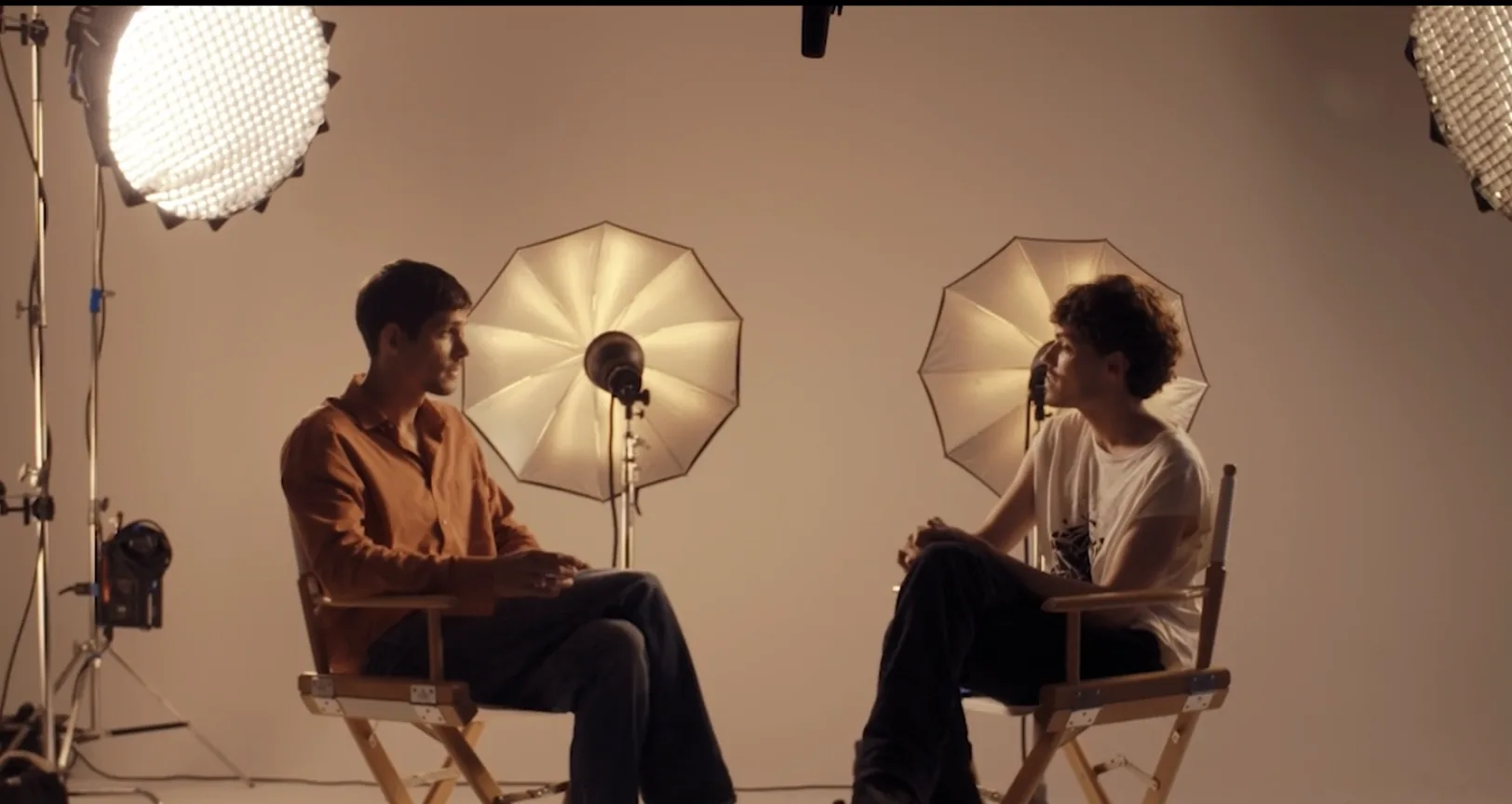 Footage
 Interview
Name goes hereTitle, Company
Interview
Name goes hereTitle, Company
We do not put our mark on client work beyond the agreed watermark cases. White label and agency partnership work carries no Raised Media branding at all.
Credit lines
If you are crediting us in a programme, a press piece or an end card, take the line from here rather than writing one. Tap any row to copy it.
Raised Media Co. is a video production and photography agency in New York, New York.
First mention, then after
Raised Media Co. on first mention. Raised Media every time after that.
Never the initials
Never shortened to three letters in anything public. It reads like a filing code.
One handle
@raisedmediaco on every platform, with no variation and no underscores.
Files
The first three are white artwork on a transparent background, so they will look empty in a light file browser. Put them on a dark ground. If you need vector, or a size that is not here, email us.





Something not covered here
Tymel Young, Creative Director · ty@raisedmediaco.com