
Branding
Who to hire for a website, sorted by the kind of site you need. And the one job that sits outside all of it, which is where we come in.
Branding
Who to hire for a website, sorted by the kind of site you need. And the one job that sits outside all of it, which is where we come in.

Our last post on event production companies got a lot of traction, so we're doing another one.
We're in this industry, but we're also consumers of it. We hire people, we get hired, and we pay attention to who's doing good work. Websites are the other side of that.
Quick note before the names. We're not on this list, and it's not us being humble. We do something different.
We're a video and photo team that started building pages for the content we make. Campaign pages, event pages, activation pages. Not full websites, no big CMS builds, no ecommerce. So if you need a real website, one of the companies below is your call, not us. More on where the line sits at the end.
Nobody here is number one, because "website" means five different jobs.
A twelve-page company site with a CMS, a Shopify store, and a one-page launch are not the same project. The team that's great at one is often the wrong fit for another. So here's who to look at based on what you're building. Details come from what these companies publish about themselves, so double-check when you talk to them.
DD.NYC does custom web design and WordPress builds out of New York, and they've landed on the Inc. 5000 list. Solid pick for a full corporate site.
Digital Silk builds custom sites for B2B, B2C, and ecommerce, with Sony, P&G, and the NFL in their portfolio. Bigger-company energy.
Studio Simpatico is Brooklyn-based and does user-centered design, branding, and custom WordPress. They work across nonprofits, fintech, beauty, and fashion, which is a nice range.
View Source is a Brooklyn agency founded in 2019 doing custom design plus ecommerce on Shopify and WordPress, with SEO and conversion work attached. Good when the site has to sell, not just look right.
Sometimes the site isn't the real problem. The brand underneath it is.
Deserve Studio has been at it over 13 years, doing brand identity alongside no-code builds in Framer and Webflow, with clients like Cisco, Vodafone, and Talkdesk.
Inovāt handles brand repositioning and site overhauls together, so the two move as one project instead of two.

(Page Designed by Raised Media Co)
This lane has gotten good! No-code used to mean compromise. Now some of the sharpest sites out there are built this way.
We build in Framer ourselves, so we'll say why we like it. You get real design control without a developer sitting in the middle of every change. It's fast, it handles motion and video properly, and it loads well on a phone, which matters more than most people plan for.
The part clients care about most is what happens after launch. You can go in and change a headline, swap a photo, update a date, without emailing anyone or waiting three days. For a brand running campaigns, that's the difference between a page that stays current and one that quietly goes stale.
It's not the right tool for everything. A huge site with heavy ecommerce or deep integrations usually belongs somewhere else, and the teams below will tell you the same.
Refokus builds beautiful, motion-heavy sites and counts Framer itself among their clients, which tells you something.
Flow Ninja was Webflow's Enterprise Partner of the Year in 2023 and handles complex CMS migrations, so they're built for bigger jobs.
VictorFlow is a Webflow Premium Partner working in Framer too, mostly with startups and SaaS brands.
Ramotion works with Mozilla, Clearbit, and Okta, and publishes rates in the $150 to $200 an hour range.
(Page Designed by Raised Media Co)
This is the gap we kept running into, and why we started doing this at all.
You hire one of the teams above and get a great website. Then a campaign happens. Or an event, or an activation, or a product drop. You've got a video, a set of photos, a moment with a short window... and nowhere right to put it.
The homepage is too broad. Adding it to the site means a ticket, a queue, and a template that fights the content. So it ends up as a social post and a link to nothing.
That's the piece we build. One page, made around the content, because we made the content.
Which is the real difference. A web team starts with a brand guide and a blank page, then asks you to send assets. We start from the footage and the photos, since we were the ones in the room. We know which ten seconds open the page, which frame deserves to run full width, and how the whole thing should build. Nobody has to explain the story to us in a kickoff call.
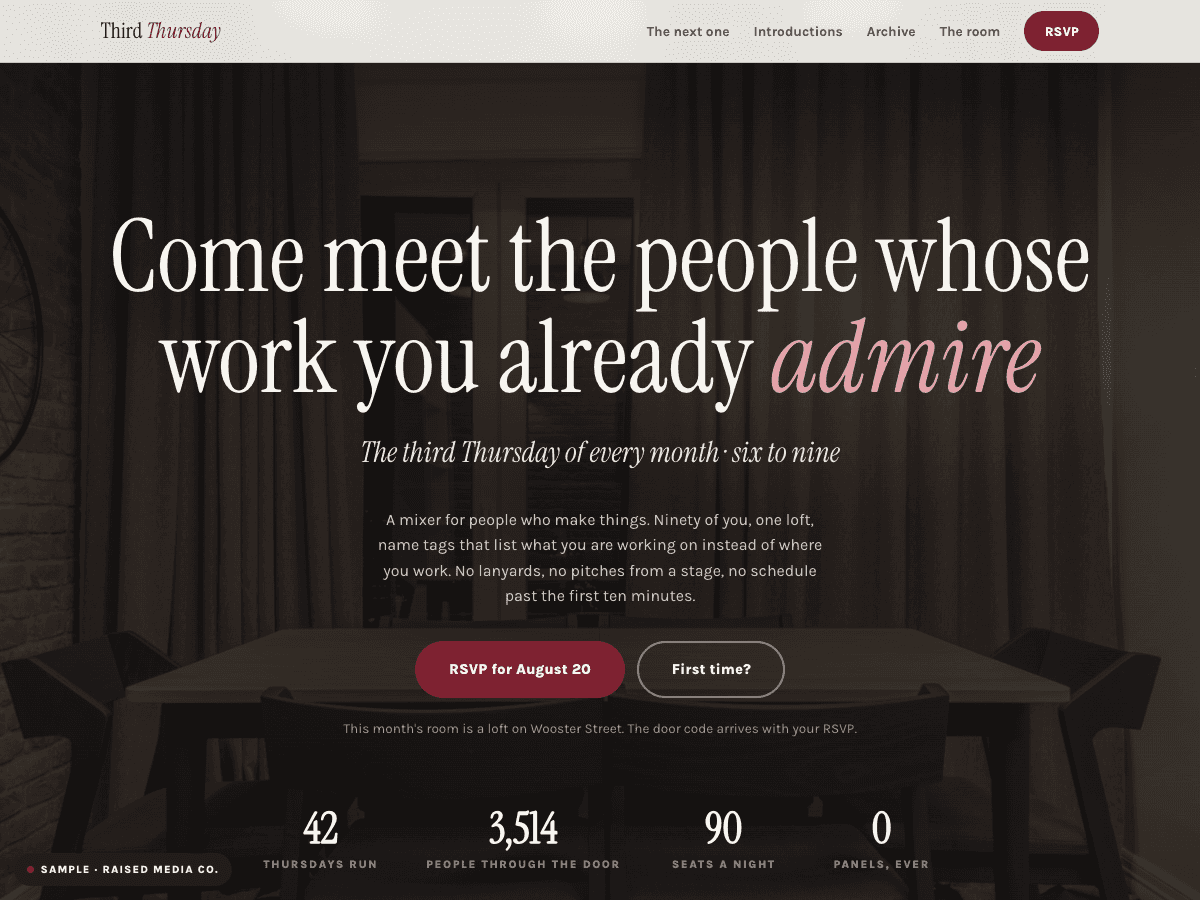
We build it in Framer and hand it over, so you can update it yourself after. It plugs into the site you already have instead of replacing it. We do it for events, activations, restaurants, and fashion. The longer version is in landing page vs website.
So it's not either-or. Most brands need a real website and then a place to put the moments. Two jobs, two teams, and knowing which one you're facing saves everybody a lot of time!
Ask who maintains it after launch. A site you can't update yourself becomes someone else's retainer.
Ask what happens on a phone, because that's where most people will see it. Ask how fast it loads with your video on it, which is where a lot of pretty sites fall apart. And ask what you own when it's done, the files, the design, the account.
Then match the team to the job. A brand shop will make you something beautiful. An ecommerce team will make you something that sells. A no-code shop will get you live fast. All good answers to different questions.
—
Raised Media Co. is a New York City visual production company. Video, photography, and web design, built for brands.