
Strategy
AI site builders are genuinely good now, and they've solved the build. What they haven't solved is the content. Three ways to make an AI-built site feel premium and actually convert.
Strategy
AI site builders are genuinely good now, and they've solved the build. What they haven't solved is the content. Three ways to make an AI-built site feel premium and actually convert.

A founder with no developer can describe a site in plain English and have it live by Sunday. Lovable, Bolt, v0, Replit, all of it. That used to take months and a five-figure invoice.
We don't have a take on that. It's where things are, the same way everyone stopped printing brochures at some point.
What we do notice is that building the site was only ever half the job. The other half is what goes inside it, and no prompt has solved that one yet.
The reason isn't the tools being bad. It's that everyone is using the same handful of them, typing similar prompts, and pulling from the same image libraries.
The result is a kind of visual fingerprint. People can spot which generator made something before they finish reading it. Same layouts, same purple gradient, same smiling person at a laptop who must be exhausted by now.
Stock photography did this first. The same few hundred images from the free libraries show up across millions of sites, which is why they stop registering.
Eye-tracking studies link generic stock imagery to lower engagement and shorter time on page. Original imagery tracks the other way, with higher trust.
So the structure is solved and the surface is commodity. Which is where you can win.
This is the fastest upgrade available, and it's not close.
Swap the library photos for your actual space, your actual product, your actual people. Not because stock is evil, but because it's invisible. A visitor has seen that exact photo on four other sites this month, even if they couldn't tell you where.
Real commercial photography of the thing you sell does something a generated image can't. It proves the business exists in the physical world. For a restaurant, a shop, a gym, a service business, that proof is most of the sale.
Ten good frames will change how the whole site reads. You don't need a hundred.
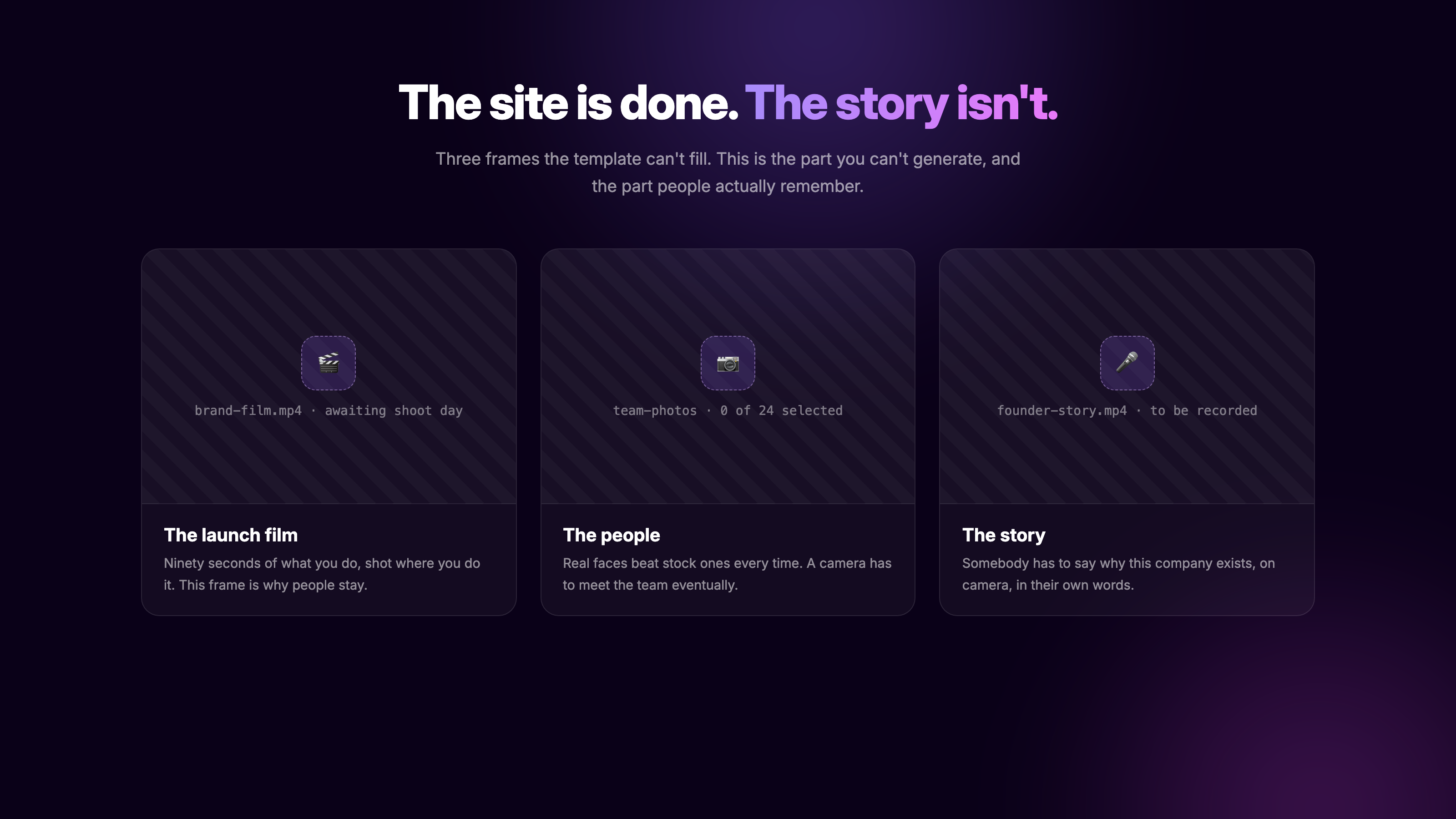
A still site feels like a brochure. A site with motion in it feels like a company with a budget, which is the perception you're buying.
That doesn't mean a two-minute brand film. A short loop at the top, a few seconds of your team working, the product in someone's hands. Enough that the page has a pulse.
Motion also holds people longer, and time on page is the thing everything else downstream depends on. If someone stays, they read. If they read, they might buy.
Worth knowing that video behaves differently on a site than on social, and a heavy file will undo the whole effect by slowing the page down. Small and right beats big and slow.
Here's the one that moves money. Every generated site says the same reassuring things about quality and dedication. Nobody believes any of it, because it costs nothing to type.
What can't be typed is proof. A photo of the actual team, a customer on camera saying what happened, the work itself shown at full size instead of described in a paragraph.
That's the difference between a site that looks legitimate and a site that closes. Trust is what converts, and trust comes from specifics that only you could have.
If your site says "trusted by leading brands," name them. Leading brands love being named. If you did something you're proud of, show it at full size.
The vaguer the claim, the more it reads like everyone else's, which is the one thing you were trying to avoid.
There's a lot of noise right now about AI coming for video. Some of it will turn out to be right.
Here's what it can't do. It can't generate your founder. It can't generate the guy who's run your kitchen for eleven years, or the person your customers ask for by name, or the way your team talks to each other when nobody's directing them.
Those people exist once. They're the only thing on your site a competitor can't prompt their way into, and they're sitting right there in your office for free.
Which makes putting them on camera a stranger kind of advantage than it used to be. The more of the internet gets generated, the more weight a real face carries. That's also why synthetic performers are starting to come with a warning label.
Less than the website used to. That's the shift.
The money that would have gone to a six-week build can go to the content instead, which is now the part that separates you. A focused photo day, a short video, and someone thinking about what the page needs to say.
We build pages for brands around content we make, and we'd say the same thing to someone who built their own site in a weekend. The structure matters less than what's on it.
For a lot of businesses, yes. The build is fine. Genuinely fine.
It stops being fine when the site is doing sales work, when someone lands there deciding whether to spend real money with you. At that point the generic surface is costing you, quietly, and no amount of prompting fixes it.
Anyway. The hard part was never the code. It was always having something worth showing, and that part still gets made by people.
Raised Media Co. is a New York City visual production company. Video, photography, and web design, built for brands.